Informática Educativa Carlosfmur@gmail.com: Rugged computer: A rugged (or ruggedized , but also ruggedised ) computer is a co...
A rugged (or ruggedized, but also ruggedised) computer is a computer specifically designed to operate reliably in harsh usage environments and conditions, such as strong vibrations, extreme temperatures and wet or dusty conditions
Friday, 2 October 2015


Thursday, 1 October 2015
Basic Linear Algebra Subprograms (BLAS)


BLAS (Basic Linear Algebra Subprograms) is a specification that prescribes a set of low-level routines for performing common linear algebra operations such as vectoraddition, scalar multiplication, dot products, linear combinations, and matrix multiplication. They are the de facto standard low-level routines for linear algebra libraries; the routines have bindings for both C and Fortran. Although the BLAS specification is general, BLAS implementations are often optimized for speed on a particular machine, so using them can bring substantial performance benefits. BLAS implementations will take advantage of special floating point hardware such as vector registers or SIMD instructions.
It originated as a Fortran library in 1979[1] and its interface was standardized by the BLAS Technical (BLAST) Forum, whose latest BLAS report can be found on the Netlib website. This Fortran library is known as the reference implementation (sometimes confusingly referred to as the BLAS library) and is not optimized for speed.
Most libraries that offer linear algebra routines conform to the BLAS interface, allowing library users to develop programs that are agnostic of the BLAS library being used. Examples of such libraries include: AMD Core Math Library (ACML), ATLAS, Intel Math Kernel Library (MKL), and OpenBLAS. ACML is no longer supported.[2] MKL is a freeware[3] and proprietary[4] vendor library optimized for x86 and x86-64 with a performance emphasis on Intel processors.[5] OpenBLAS is an open-source library that is hand-optimized for many of the popular architectures. ATLAS is a portable library that automatically optimizes itself for an arbitrary architecture. The LINPACK benchmarks rely heavily on the BLAS routine
gemm for its performance measurements.
Much numerical software uses BLAS-compatible libraries to do linear algebra computations, including Armadillo, LAPACK, LINPACK, GNU Octave, Mathematica,[6] MATLAB,[7]NumPy,[8] and R.
https://en.wikipedia.org/wiki/Basic_Linear_Algebra_Subprograms
Monday, 28 September 2015
Informática Educativa Carlosfmur@gmail.com: Excel: situación patrimonial
Informática Educativa Carlosfmur@gmail.com: Excel: situación patrimonial: La Planilla de excel para Estado de Situación Patrimonial resume de manera simple los activos corrientes y no corrientes de una emp...
Saturday, 19 September 2015
Advantages and Disadvantages of Different Network Topologies


Network topologies describe the ways in which the elements of a network are connected.
They describe the physical and logical arrangement of network nodes
Advantages and Disadvantages of...
Bus Topology
Ring Topology
Mesh Topology
Star Topology
Tree Topology
Hybrid Topology
Bus topology
Advantages
▸ The data being transmitted between two nodes passes through all the intermediate nodes. A central server is not required for the management of this topology.
▸ The traffic is unidirectional and the data transmission is high-speed.
▸ In comparison to a bus, a ring is better at handling load.
▸ The adding or removing of network nodes is easy, as the process requires changing only two connections.
▸ The configuration makes it easy to identify faults in network nodes.
▸ In this topology, each node has the opportunity to transmit data. Thus, it is a very organized network topology.
▸ It is less costly than a star topology.
Disadvantages
▸ The failure of a single node in the network can cause the entire network to fail.
▸ The movement or changes made to network nodes affect the entire network's performance.
▸ Data sent from one node to another has to pass through all the intermediate nodes. This makes the transmission slower in comparison to that in a star topology. The transmission speed drops with an increase in the number of nodes.
▸ There is heavy dependency on the wire connecting the network nodes in the ring.
Back to Index
Read more at Buzzle: http://www.buzzle.com/articles/advantages-and-disadvantages-of-different-network-topologies.html
http://www.buzzle.com/articles/advantages-and-disadvantages-of-different-network-topologies.html
Computational science


Computational science (also scientific computing or scientific computation) is concerned with constructing mathematical models and quantitative analysis techniques and using computers to analyze and solve scientific and engineering problems. In practical use, it is typically the application of computer simulation and other forms of computation from numerical analysis and theoretical computer science to problems in various scientific disciplines.
The field is different from theory and laboratory experiment which are the traditional forms of science and engineering. The scientific computing approach is to gain understanding, mainly through the analysis of mathematical models implemented on computers.
Scientists and engineers develop computer programs, application software, that model systems being studied and run these programs with various sets of input parameters. In some cases, these models require massive amounts of calculations (usually floating-point) and are often executed on supercomputers or distributed computing platforms.
Numerical analysis is an important underpinning for techniques used in computational science.
Programming languages and computer algebra systems commonly used for the more mathematical aspects of scientific computing applications include R (programming language), TK Solver, MATLAB, Mathematica, SciLab, GNU Octave, Python (programming language) with SciPy, and PDL. The more computationally intensive aspects of scientific computing will often use some variation of C or Fortran and optimized algebra libraries such as BLAS or LAPACK.
https://en.wikipedia.org/wiki/Computational_science
Friday, 18 September 2015
Lenguaje de programaciòn PYTHON

Python es un lenguaje de programación interpretado cuya filosofía hace hincapié en una sintaxis que favorezca un código legible.
Se trata de un lenguaje de programación multiparadigma, ya que soporta orientación a objetos, programación imperativa y, en menor medida, programación funcional. Es unlenguaje interpretado, usa tipado dinámico y es multiplataforma.
Es administrado por la Python Software Foundation. Posee una licencia de código abierto, denominada Python Software Foundation License, que es compatible con laLicencia pública general de GNU a partir de la versión 2.1.1, e incompatible en ciertas versiones anteriores.
Structured cabling

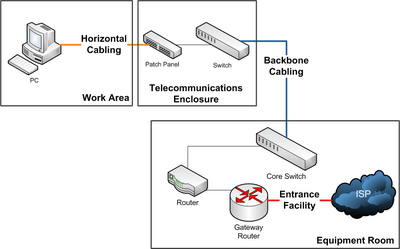
Structured cabling is building or campus telecommunications cabling infrastructure that consists of a number of standardized smaller elements (hence structured) called subsystems.
Structured cabling design and installation is governed by a set of standards that specify wiring data centers,offices, and apartment buildings for data or voice communications using various kinds of cable, most commonly category 5e (CAT-5e), category 6 (CAT-6), and fiber optic cabling and modular connectors. These standards define how to lay the cabling in various topologies in order to meet the needs of the customer, typically using a central patch panel (which is normally 19 inch rack-mounted), from where each modular connection can be used as needed. Each outlet is then patched into a network switch (normally also rack-mounted) for network use or into an IP or PBX (private branch exchange) telephone system patch panel.
https://en.wikipedia.org/wiki/Structured_cabling
Informática Educativa Carlosfmur@gmail.com: Computational statistics
Informática Educativa Carlosfmur@gmail.com: Computational statistics: Computational statistics , or statistical computing , is the interface between statistics and computer science . It is the ar...
Wednesday, 16 September 2015
Small Basic
Small Basic es un proyecto que está destinado a hacer la programación divertida de nuevo. Al proporcionar un lenguaje de programación sencillo y fácil de aprender en un entorno de desarrollo acogedor, Small Basic hace que la programación sea muy sencilla. Ideal para niños y adultos por igual, Small Basic ayuda a los principiantes a dar el primer paso en el maravilloso mundo de la programación.
http://social.technet.microsoft.com/wiki/contents/articles/17328.bienvenido-a-small-basic-es-es.aspx
Tuesday, 8 September 2015
Open Systems Interconnection model
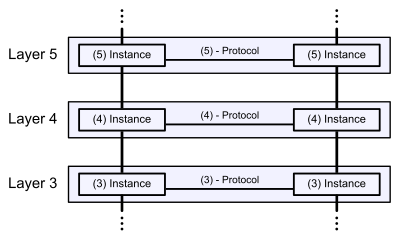
The Open Systems Interconnection model (OSI Model) is a conceptual model that characterizes and standardizes the communication functions of a telecommunication or computing system without regard of their underlying internal structure and technology. Its goal is the interoperability of diverse communication systems with standard protocols. The model partitions a communication system into abstraction layers. The original version of the model defined seven layers.
A layer serves the layer above it and is served by the layer below it. For example, a layer that provides error-free communications across a network provides the path needed by applications above it, while it calls the next lower layer to send and receive packets that comprise the contents of that path. Two instances at the same layer are visualized as connected by a horizontal connection in that layer.
The model is a product of the Open Systems Interconnection project at the International Organization for Standardization (ISO), maintained by the identification ISO/IEC 7498-1.
https://en.wikipedia.org/wiki/OSI_model
Saturday, 5 September 2015
Big O Analysis in computer science


What is Big O Analysis in computer science – a tutorial
First and foremost, do not even walk into a software interview without knowing what Big O Analysis is all about – you will embarrass
yourself. Big O Notation is simply something that you must know if you expect to get a job in this industry. Here we present a
tutorial on Big O Notation, along with some simple examples to really help you understand it. You can consider this article to be
sort of a big O notation for dummies tutorial, because we really try to make it easy to understand.
When solving a computer science problem there will usually be more than just one solution. These solutions will often be in the form
of different algorithms, and you will generally want to compare the algorithms to see which one is more efficient.
This is where Big O analysis helps – it gives us some basis for measuring the efficiency of an algorithm. A more detailed explanation
and definition of Big O analysis would be this: it measures the efficiency of an algorithm based on the time it takes for the
algorithm to run as a function of the input size. Think of the input simply as what goes into a function – whether it be an array of
numbers, a linked list, etc.
Big O Notation Practice Problems
Even if you already know what Big O Notation is, you can still check out the example algorithms below and try to figure out the Big O
Notation of each algorithm on your own without reading our answers first. This will give you some good practice finding the Big O
Notation on your own using the problems below.
See more:http://www.programmerinterview.com/index.php/data-structures/big-o-notation/
Friday, 4 September 2015
GNU/Linux


Linux, es un kernel, es decir, el núcleo de un Sistema Operativo, mientras que GNU/Linux, el Sistema Operativo que utiliza el Kernel Linux como núcleo, creado, difundido y promovido a través del Proyecto GNU, por la Free Software Foundation, organización sin fines de lucro, fundada por Richard Stallman, principal precursor del Software Libre.
https://librosweb.es/libro/python/capitulo_1/introduccion_al_sistema_operativo_gnu_linux.html
Tuesday, 1 September 2015
ciencias de la computación


Las ciencias de la computación o ciencias computacionales son aquellas que abarcan las bases teóricas de la información y la computación, así como su aplicación en sistemas computacionales. El cuerpo de conocimiento de las ciencias de la computación es frecuentemente descrito como el estudio sistemático de los procesos algorítmicos que describen y transforman información: su teoría, análisis, diseño, eficiencia, implementación y aplicación.
https://es.wikipedia.org/wiki/Ciencias_de_la_computaci%C3%B3n
Sunday, 30 August 2015
Games to be featured on our blog!!!
How to nominate games to be featured on our blog!!!
RATE THIS


28 Aug 2015 4:19 PM
http://blogs.msdn.com/b/smallbasic/archive/2015/08/28/how-to-nominate-games-to-be-featured-on-our-blog.aspx
Wednesday, 26 August 2015
Cellular network


A cellular network or mobile network is a communications network where the last link is wireless. The network is distributed over
land areas called cells, each served by at least one fixed-location transceiver, known as a cell site or base station. In a cellular
network, each cell uses a different set of frequencies from neighboring cells, to avoid interference and provide guaranteed bandwidth
within each cell.
When joined together these cells provide radio coverage over a wide geographic area. This enables a large number of portable
transceivers (e.g., mobile phones, pagers, etc.) to communicate with each other and with fixed transceivers and telephones anywhere
in the network, via base stations, even if some of the transceivers are moving through more than one cell during transmission.
Cellular networks offer a number of desirable features:
More capacity than a single large transmitter, since the same frequency can be used for multiple links as long as they are in
different cells
Mobile devices use less power than with a single transmitter or satellite since the cell towers are closer
Larger coverage area than a single terrestrial transmitter, since additional cell towers can be added indefinitely and are not
limited by the horizon
Major telecommunications providers have deployed voice and data cellular networks over most of the inhabited land area of the Earth.
This allows mobile phones and mobile computing devices to be connected to the public switched telephone network and public Internet.
Private cellular networks can be used for research or for large organizations and fleets, such as dispatch for local public safety agencies or a taxicab company.
https://en.wikipedia.org/wiki/Cellular_network
cache memory definition

Cache memory, also called CPU memory, is random access memory (RAM) that a computer microprocessor can access more quickly than it can access regular RAM. Thismemory is typically integrated directly with the CPU chip or placed on a separate chip that has a separate bus interconnect with the CPU.
Cache memory is fast and expensive. Traditionally, it is categorized as "levels" that describe its closeness and accessibility to the microprocessor:
- Level 1 (L1) cache is extremely fast but relatively small, and is usually embedded in the processor chip (CPU).
- Level 2 (L2) cache is often more capacious than L1; it may be located on the CPU or on a separate chip or coprocessor with a high-speed alternative system bus interconnecting the cache to the CPU, so as not to be slowed by traffic on the main system bus.
- Level 3 (L3) cache is typically specialized memory that works to improve the performance of L1 and L2. It can be significantly slower than L1 or L2, but is usually double the speed of RAM. In the case of multicore processors, each core may have its own dedicated L1 and L2 cache, but share a common L3 cache. When an instruction is referenced in the L3 cache, it is typically elevated to a higher tier cache.
Tuesday, 25 August 2015
Wireless connectivity


Wireless capability is a key requirement for most enterprise mobility applications, and it has been reported that wireless-transmission failure rates are three times higher for non-rugged notebooks compared to rugged units. This difference is attributed to the greater experience of rugged-notebook vendors at integrating multiple radios into their products. Each transmission failure leads to five to ten minutes in lost productivity as the user has to re-login to the company network through a VPN.
Since enterprises are turning to cellular networks to enable full-time connectivity for their users, major vendors of rugged computers offer both built-in wireless LAN andwireless WAN capabilities, and partner with cellular carriers, such as Verizon and AT&T, as part of their offerings.[12][13] During the handoff between the various wireless LAN and wireless WAN connections, a mobile VPN allows the connection to persist, creating an always-connected infrastructure that is simpler for the user and eliminates application crashes and data loss.
https://en.wikipedia.org/wiki/Rugged_computer
https://en.wikipedia.org/wiki/Rugged_computer
Saturday, 22 August 2015
Rugged computer


A rugged (or ruggedized, but also ruggedised) computer is a computer specifically designed to operate reliably in harsh usage environments and conditions, such as strong vibrations, extreme temperatures and wet or dusty conditions. They are designed from inception for the type of rough use typified by these conditions, not just in the external housing but in the internal components and cooling arrangements as well. In general, ruggedized and hardened computers share the same design robustness and frequently these terms are interchangeable.
Typical end-user environments for rugged laptops, tablet PCs and PDAs are public safety, field sales, field service,manufacturing, retail, healthcare, transportation/distribution and the military. They are used in the agricultural industries and by individuals for recreational activities, as well, such as hunting or geocaching.
Friday, 14 August 2015
Big O notation
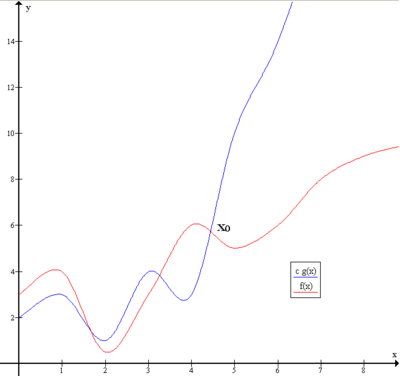
Big O notation characterizes functions according to their growth rates: different functions with the same growth rate may be represented using the same O notation. The letter O is used because the growth rate of a function is also referred to as order of the function. A description of a function in terms of big O notation usually only provides an upper bound on the growth rate of the function. Associated with big O notation are several related notations, using the symbols o, Ω, ω, and Θ, to describe other kinds of bounds on asymptotic growth rates.
Big O notation is also used in many other fields to provide similar estimates.
https://en.wikipedia.org/wiki/Big_O_notation
Subscribe to:
Posts (Atom)